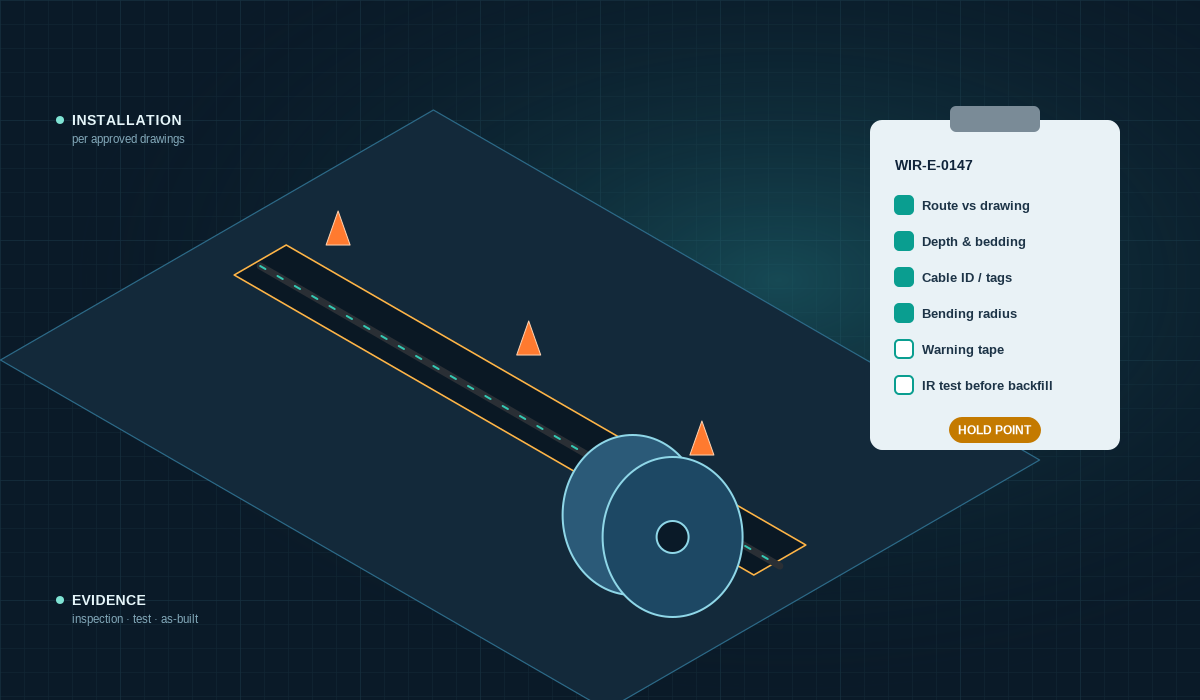
Site engineering converts approved designs into installed, inspected, tested and documented systems. The electrical site engineer's real product is not only the installation — it is the evidence trail that proves the installation complies.
What this department covers
- Roles and responsibilities on site
- ITPs, method statements and hold points
- Material submittals and approvals
- Material and work inspections
- Non-conformance management
- Coordination, RFIs and document control
- As-builts and handover
01Roles on an electrical site
| Role | Main responsibilities |
|---|---|
| Electrical site engineer | Plans and supervises installation, coordinates trades, raises inspection requests, resolves technical issues |
| QA/QC engineer / inspector | Manages ITPs, inspections, records, NCRs and audits; independent of production pressure |
| Testing & commissioning engineer | Plans and performs tests, manages test records and energisation readiness |
| Document controller | Controls drawing and document revisions, transmittals and registers |
| Consultant / engineer's representative | Reviews submittals, witnesses inspections and tests, accepts work for the client |
| Authorised person (HV/LV) | Controls switching, isolation and safety documents on energised systems |
02The QA/QC workflow
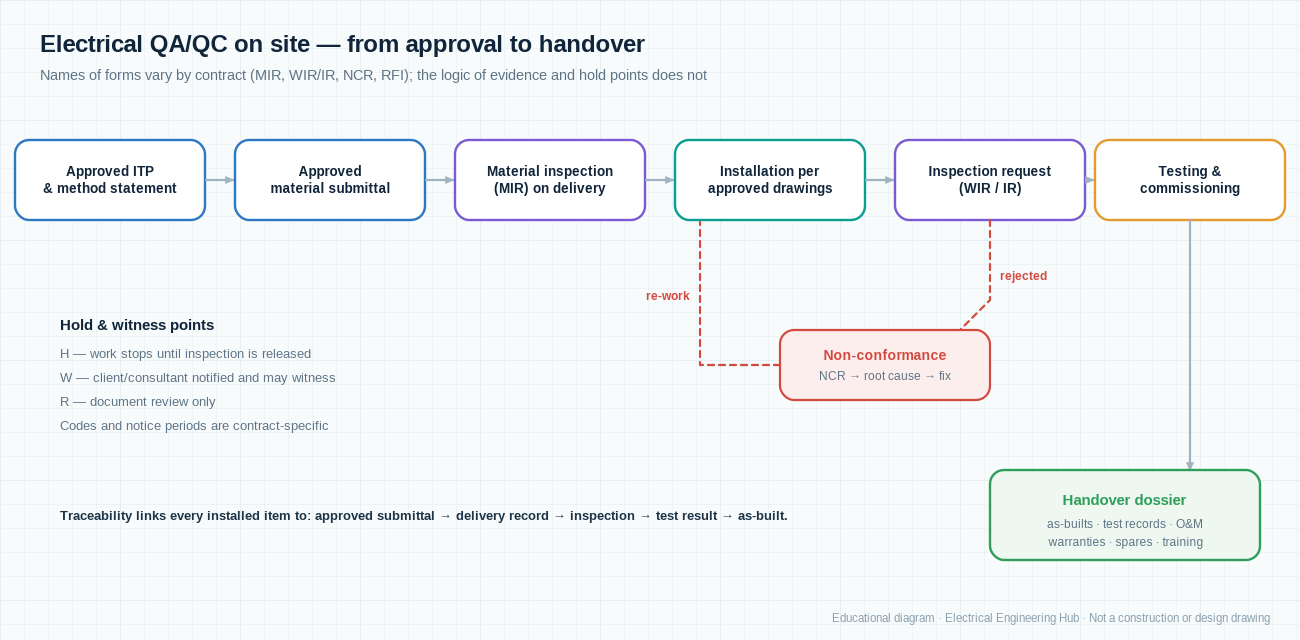
- Plan quality.Prepare and obtain approval of the ITP and method statements before work starts. The ITP lists each activity, the reference documents, acceptance criteria, records, and who inspects at which hold, witness or review point.
- Approve materials.Submit materials with datasheets, test certificates and compliance statements; procure only approved items.
- Inspect deliveries.Material inspection requests (MIRs) confirm delivered items match the approved submittal and are undamaged.
- Install to approved drawings.Using the latest approved revision, issued through document control.
- Inspect work.Work inspection requests (WIRs) at the defined stages — e.g. before backfilling a trench, before closing a ceiling, after termination.
- Test and commission.Per ITP, with records reviewed before energisation.
- Close out.NCRs closed, punch list cleared, as-builts and handover documents submitted.
03Material submittals
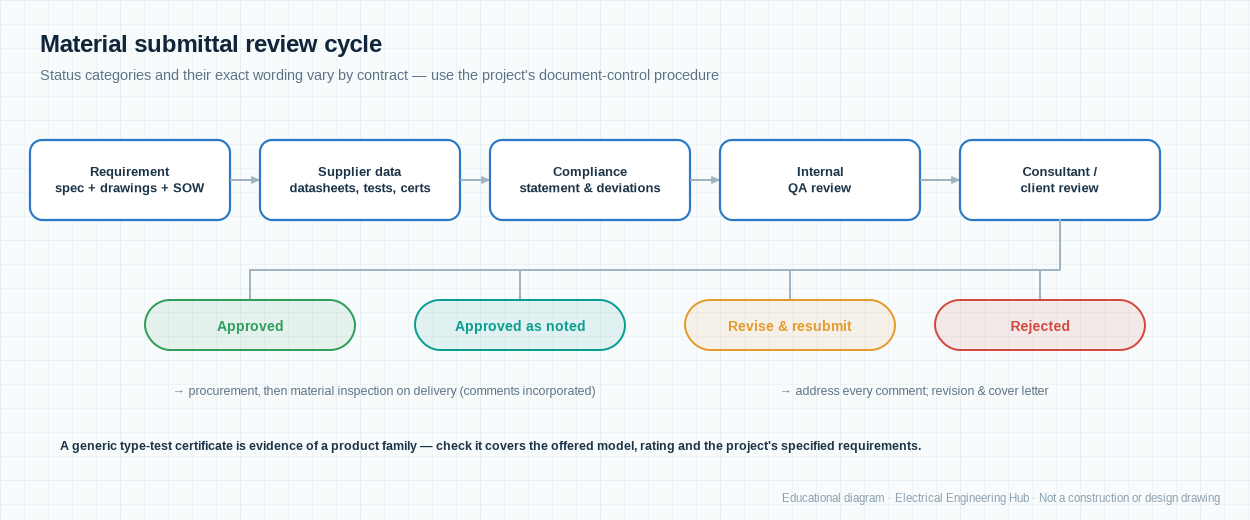
A strong submittal makes the reviewer's job easy: it clearly identifies the item and where it is used, shows evidence for every specified requirement, and declares any deviation openly. The Material Submittal Tracker helps track revisions, review status and procurement.
| Section | Content |
|---|---|
| Cover / transmittal | Item, specification section, drawing references, revision, contractor review stamp |
| Compliance statement | Clause-by-clause comparison: required / offered / compliant / remarks |
| Technical data | Datasheets with offered model highlighted, drawings, curves |
| Evidence | Type-test reports, routine-test certificates, certifications and approvals as required |
| Manufacturer information | Credentials, local agent, warranty, references if required |
| Samples / mock-ups | Where the specification requires them |
A type-test certificate covers a design, not every variant. Check that the tested design matches the offered model, ratings and configuration — and that the certificate is current and from a recognised laboratory where the specification requires it.
04Inspections on site
| Work | Inspection stage | What the inspector checks |
|---|---|---|
| Cable trench | Before cable laying; before backfilling | Depth, bedding, route, separation, cable tags, pre-backfill test |
| Containment | After installation, before cabling | Supports, fixings, bends, earthing continuity, fire-stopping provisions |
| Cable pulling | During and after | Bending radius, tension, damage, segregation, labels |
| Terminations | Before covers are closed | Lug type, crimping, torque marks, phasing, glands, earthing |
| Switchboards | After installation | Alignment, anchoring, busbar connections, labelling, clearances |
| Earthing | Before concealment | Electrode depth, connections, conductor sizes, test pits |
| Lighting columns | After erection | Foundation, verticality, numbering, base compartment |
05Non-conformances
A non-conformance report (NCR) records work or material that does not meet requirements. A good NCR process does not stop at the fix: it identifies the root cause, defines corrective action (fix this instance) and preventive action (stop it happening again), and verifies closure. Disposition options typically include rework, repair, replace, or "use as is" with documented engineering acceptance.
| Recurring issue | Preventive action |
|---|---|
| Work done to superseded drawing revision | Document control briefings; withdraw old revisions from site |
| Unapproved material installed | Store control linked to approval status; MIR before issue |
| Bending radius or cable damage | Pulling plans; supervision; rollers and correct drum handling |
| Missing torque marks / loose connections | Torque procedure and calibrated tools; inspection hold point |
| Incomplete test records | Standard test forms; record review before acceptance |
06Coordination, RFIs and document control
Electrical work interfaces with civil, structural, mechanical, ICT, fire and utility work. Clashes are cheapest to resolve on drawings: coordinated services drawings, sleeves and openings agreed with structure, and early confirmation of equipment sizes and weights. When the design is unclear or conflicting, a request for information (RFI) obtains a recorded answer from the designer — never resolve a design question informally and undocumented.
07As-builts and handover
As-built drawings record what was actually installed: cable routes with depths and joint positions, final equipment locations, circuit numbers, settings and any approved deviations. They are prepared progressively — marked up as work proceeds — not reconstructed at the end. The Cable Schedule Template and Electrical Inspection & Testing Log support this record-keeping.
Weekly electrical QA/QC review
0 / 8- Documents
- Inspection & testing
- Site
08Troubleshooting site issues
| Situation | Practical response |
|---|---|
| Equipment delivered differs from approved submittal | Quarantine; raise NCR/MIR rejection; obtain technical evaluation before any use |
| Route obstruction requires change | Raise RFI with proposed alternative; check impact on cable length, voltage drop and rating |
| Consultant rejects test results | Review method and criteria; retest with corrected procedure; agree acceptance basis in writing |
| Late design change | Assess impact on materials already procured and installed; update registers and as-builts |
09Test yourself
Ten questions with explanations. Scores are saved only in your browser and feed your learning progress dashboard.