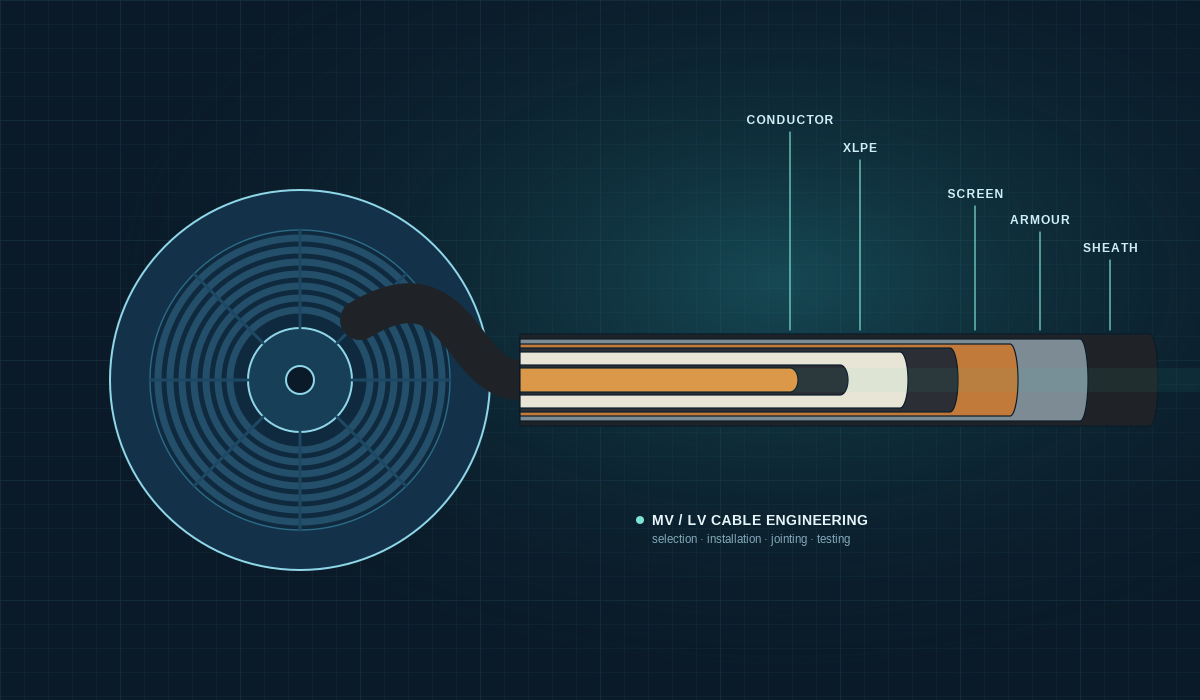
"PVC cable" and "XLPE cable" usually describe the insulation around each conductor — the layer that sets the cable's temperature rating, current capacity and short-circuit performance. The outer sheath is a separate layer that mainly gives mechanical and environmental protection.
01Insulation vs outer sheath
- Insulation — directly around each core. Decides the maximum conductor temperature (PVC 70 °C, XLPE 90 °C).
- Outer sheath (jacket) — the outer cover of the whole cable. Common materials: PVC (general use), LSZH/LSOH (low smoke zero halogen, for buildings and public areas) and PE/MDPE/HDPE (underground and MV, better water resistance).
02PVC vs XLPE comparison
| PVC insulation | XLPE insulation | |
|---|---|---|
| Max conductor temperature | 70 °C | 90 °C |
| Short-circuit temperature | 160 °C | 250 °C |
| Current rating (same size) | Lower | Typically 15–25% higher |
| Resistance used for voltage drop | R at 70 °C | R at 90 °C |
| Cost | Lower | Slightly higher |
| Typical use | Indoor final circuits, building wires, control cables | LV feeders, underground, large sizes, all MV cables |
03Where each is used
PVC insulated: lighting and socket final circuits, single-core building wire in conduit or trunking, small sub-mains, control cables.
XLPE insulated: transformer-to-MDB and MDB-to-SMDB feeders, underground armoured cables, large sizes (95–300 mm² and above), high-current or long runs, hot environments, and medium-voltage cables (11 kV, 13.8 kV, 33 kV).
04Reading cable designations
Designations are read from the conductor outwards:
| Written as | Meaning |
|---|---|
| Cu/PVC/PVC | Copper, PVC insulation, PVC sheath |
| Cu/XLPE/PVC | Copper, XLPE insulation, PVC sheath |
| Cu/XLPE/SWA/PVC | Copper, XLPE insulation, steel wire armour, PVC outer sheath |
| Cu/XLPE/LSZH | Copper, XLPE insulation, low-smoke zero-halogen sheath |
| Al/XLPE/LLDPE/PVC | Aluminium, XLPE insulation, LLDPE and PVC sheath layers (check the datasheet for each layer's role) |
05Effect on voltage drop
Insulation type changes the operating temperature, and therefore the resistance. For a 4 mm² copper conductor: about 5.52 Ω/km at 70 °C (PVC) and 5.88 Ω/km at 90 °C (XLPE). Use the matching value in the voltage drop calculator — its cable preset switches between PVC and XLPE for you. Full values are in the cable resistance table.
FAQFrequently asked questions
What is the difference between PVC and XLPE cable?
The difference is the insulation around each conductor. PVC insulation is rated for a 70 °C conductor temperature; XLPE (cross-linked polyethylene) is rated for 90 °C, so an XLPE cable of the same size usually carries more current and withstands higher short-circuit temperatures (250 °C vs 160 °C).
Does a PVC outer sheath mean the cable is PVC insulated?
No. The outer sheath and the insulation are different layers. A cable written as XLPE/PVC has XLPE insulation and a PVC outer sheath. Always check the material around the cores.
Which is better for underground cables?
Underground LV feeders and all MV cables are normally XLPE insulated, often armoured (for example XLPE/SWA/PVC), because XLPE handles heat and moisture better. Follow the project and utility specification.
Does insulation type affect voltage drop?
Indirectly. The insulation sets the operating temperature used for the resistance value: R at 70 °C for PVC and R at 90 °C for XLPE. The sheath material does not affect voltage drop.
What does Al/XLPE/LLDPE/PVC mean?
Cable designations are read from the inside out: aluminium conductor, XLPE insulation, then the sheath layers (here LLDPE and PVC). The exact role of each sheath layer varies by manufacturer, so confirm it on the datasheet or cross-section drawing.